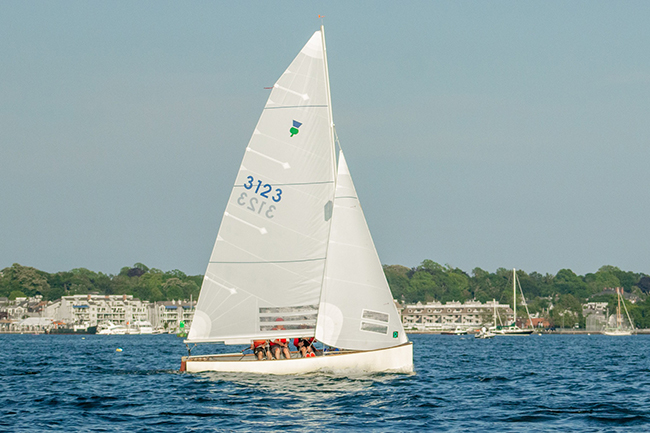
I, like most of our readers, have done most of my sailing in cruising and racer-cruising boats that are in the 35 to 50-foot range. These are boats that are large enough to make long coastal and offshore passages and to hold all the gear, equipment and stores that make the cruising life safe, free and fun. But if there is anything missing on boats of this size, it may be the distance we are from the water and the slowness of the boats’ reaction to changes in trim, weight distribution and puffs of wind. I learned to sail in Beetle Cats, with gaff-headed mainsails, a tiller, a large centerboard and a shallow draft displacement hull. In a Beetle Cat, you are very close to the water and the large rudder and tiller give you immediate feedback on how you are sailing. Missing that closeness to the wind and water, a few years ago my son Si and I bought an old, 17-foot Thistle, hull 3123, and have spent winters restoring it and summers racing in the local fleet and puttering around Narragansett Bay. Even though the Thistle design stems from the 1940s, it is still a great sailing dinghy, with a huge mainsail, jib and fractional spinnaker. In breezes over 10 knots, it will plane downwind and the rudder will hum with pleasure. It’s a three-man boat for racing, but Rosie and I can handle it fine for bay cruises. The feel of the tiller, the tug of the mainsheet, the tweak of the vang and the outhaul and the set of the jib all play together in a kind of harmony with the wind and the water so close at hand. Thistles are not actually simple boats, but when out sailing, scooting along with wind in our hair and the sails drawing nicely, the pure joy of sailing comes back to us. This connection to the elements is, as they say, elemental and to us, simple sailing is truly sublime.