by Bob Osborn, S/V Pandora
After a week at sea from São Miguel, the last of the Azores behind us, we were feeling pretty good about our near thousand-mile passage to Spain. During our last night before reaching Gibraltar, our next landfall, Pandora had handled some rough weather overnight, gusts on the beam in the mid-30s and big seas that broke over the deck several times. By morning, the worst had eased, and soon the coast of Morocco was just visible off the starboard bow. We were tired but relieved—and the remaining dozen miles looked easy but that was not the case at all.
For months I had been following reports of orca attacks on sailboats along the Iberian coast—rudders broken clean off, stainless rudder posts bent and a few boats sunk. The Strait of Gibraltar has been the epicenter of this strange behavior since it began around 2020. There are a dozen or so individuals, mostly juveniles, believed to be involved. Scientists think they are “practicing” hunting or simply playing, attacking rudders for sport. In keeping with our habit of giving notable animals names, individual Iberian orca that have been involved in the attacks with vessels are referred to as Gladis.
Before leaving the Azores, I had done my homework. I studied www.orcas.pt, a comprehensive site that tracks orca sightings and attacks, and planned a route that seemed the least risky. The data showed very few recent encounters along the Moroccan coast, compared with many farther north where the orcas had followed the tuna. I figured we would slip through safely on that southern track.

The Hit
We were within a few miles of the narrowest part of the strait of Gibraltar, making about ten and a half knots over the ground, with a push from the current, when it happened. The boat shuddered violently, the wheel spun out of my hands, Pandora lurching to one side, and again, and again…
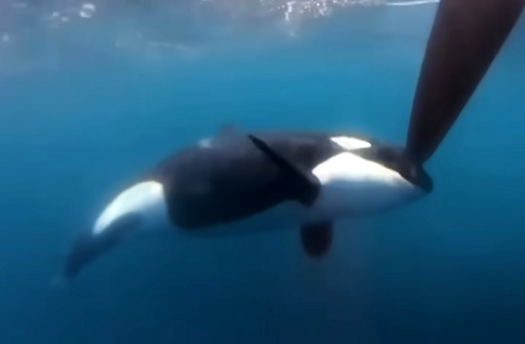
For a few seconds, none of us knew what had happened. Had we hit something? Then a massive black-and-white shape slid beneath the stern. An orca. And then another. And another. In total, maybe four or five of them, each easily fifteen to twenty feet long, closing around us, taking turns striking the rudder.
One of my crew grabbed his phone and started filming. The footage is grainy, but it captures the chaos—the sudden jerks of the wheel, the froth behind us, the unmistakable fin slicing past the transom. All I could think was “will Pandora sink?.” (You can watch the short clip here.)
It is hard to describe what that moment felt like—equal parts awe and terror. These are magnificent animals, but knowing that one well-placed hit could snap the rudder post or crack the hull was sobering.
Damage Control
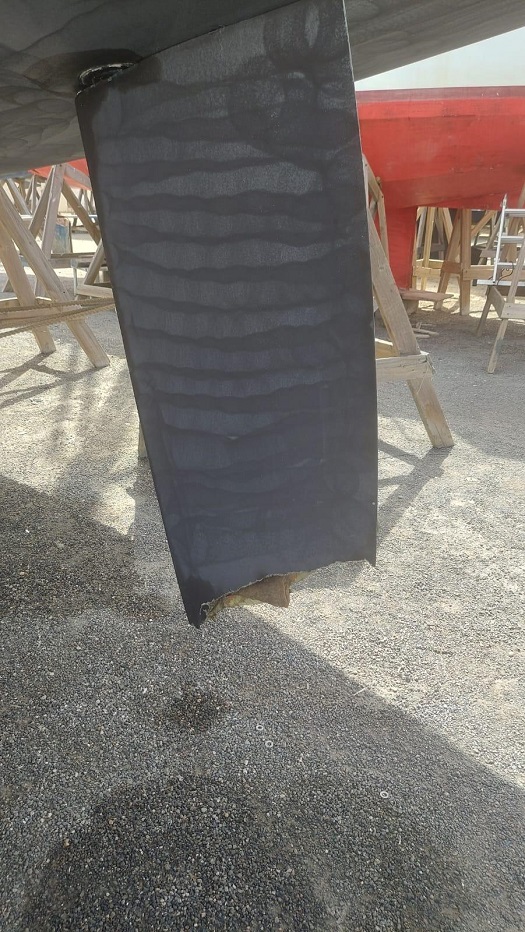
Pandora’s rudder post is carbon fiber, and it held. But the orcas managed to rip away the bottom third of the rudder, leaving it hanging by a flap of fiberglass. Later, I learned that this was a blessing in disguise: my rudder was built with a sacrificial lower section, meant to shear away cleanly in a grounding—or, apparently, an orca encounter. I have heard that once the damage is done, a portion of the rudder snapped off, that they often loose interest but keep pounding on rudders that resist their efforts, leading to more substantial damage.
Many boats are not so lucky. Yachts with stainless rudder posts often end up with bent shafts that jam against the hull, or steering linkages destroyed, leaving them without steering entirely. Once the orcas sense movement, they tend to keep hammering until something gives.
Our Hydrovane, wind vane steering, did not escape either—the reinforced plastic rudder was cracked and bent 90 degrees. Fortunately, there was enough of our primary rudder left so I could still steer, if sluggishly, so we limped on toward Gibraltar at reduced speed, dragging the remnants of both rudders through the water, substantially cutting our speed.

We tied up just before sunset, shaken but grateful to be in port. The next morning I put on a wetsuit, fired up my hookah dive compressor, and went over the side with a handsaw to finish removing the remains of the primary and Hydrovane rudders. The section of the primary rudder that had snapped remained attached by its fiberglass skin, which turned out to be fortunate as the yard in Almerimar, Spain was able to rebuild and re-bond the damaged section once we hauled out.
Lessons from the Attack
Looking back, there is a lot I might have done differently had I known then what I know now. The first and most obvious lesson is that while I thought they were farther north; it turns out, they were waiting right where we made landfall. There have been many fewer attacks in shallow water, under 20m so I should have hugged the coastline but due to crew departure plans and my desire to make port, I didn’t take the “slower” coastal route.
The orcas.pt site is an excellent tool for sailors crossing this coast. It offers an interactive map of sightings and attacks, depth data, and Telegram groups where cruisers share real-time positions. Before transiting the Gibraltar or Portuguese zones, it is worth checking the latest sightings and attacks and adjusting your track. Data from hundreds of sailors show that most interactions happen in water 20 to 1000 meters deep, where the orcas hunt bluefin tuna. Inside 20 meters, encounters are less common.
So, when approaching ports like Lagos or Cadiz, the advice is to hug the 20-meter contour—close enough that the orcas do not typically frequent those areas. Safety is not guaranteed, but statistically it reduces risk. And if you do see orcas:
· Disengage the autopilot so the wheel can spin freely.
· Keep hands loosely on the helm—a hit can whip the wheel dangerously.
· Power toward shallower water as quickly as possible.
· Do not use fireworks, or noise-makers—they are illegal in Spanish and Portuguese waters and may aggravate the whales.
· Document and report your encounter to Orcas.pt and local maritime authorities. Every report improves the database for future sailors.
· Remove auxiliary wind vane rudder as any attacks are likely to take that out, too. If needed, it can be put back in place.
· There has been some preliminary reports that towing certain acoustic devices may deter some attacks but these devices have not undergone formal testing.