
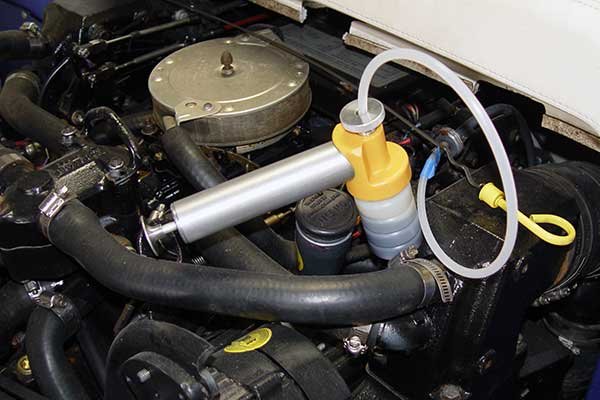
A lot goes on inside your engine. Pistons race up and down, valves snap open and closed, gears spin — and everything’s working at breakneck speed to produce the power you need to propel your boat. Because all of this happens deep in the hidden bowels of your engine, you may never know if a problem is developing until one day it just quits. Having your engine or transmission oil professionally analyzed can tell you what’s really going on inside and alert you to potentially serious problems.
How It Works
An oil sample analysis (OSA) evaluates the levels and types of metals and the presence of such contaminants as abrasives, soot, water, fuel, and engine coolant in the oil of gas and diesel engines. A lab report will flag any suspected anomalies, state possible causes, and offer some plain-English recommendations. Typical conditions that can be found by analysis include abnormal wear of metals, fuel dilution, dirt or water contamination, coolant contamination, and incorrect lubricant. Discovering any out-of-range condition early can prevent expensive repairs later on. For instance, fuel dilution will accelerate cylinder and bearing wear. High levels of solids will cause wear on bearings, pistons, cylinders, and the valve train. Excessive soot in a diesel engine can be caused by dirty injectors, weak ignition, low compression, or restricted intake or exhaust, among other things. Simply servicing a dirty injector can save an engine rebuild if caught in time.
Most OSAs will include the following:
- Spectral Exam: A spectrometer is used to find the quantity of various metals and additives in the sample — useful for finding excessive wear in bearings, pistons, rings, cylinders, valve train, and gears. It also determines the composition of any oil additives.
- Viscosity Test: The thickness of the oil at a specific temperature is tested — useful for finding fuel dilution, the breakdown of viscosity enhancers, or other contamination.
- Flash Point: Tests the temperature at which vapor from the oil ignites — contamination can cause a specific grade oil to flash higher or lower than the design flash point.
- Insolubles Test: Insolubles are typically abrasive solids — high readings are usually byproducts of incomplete combustion. Read More