June 2012 Issue of Blue Water Sailing.
In Boat Rat’s Tip: Fresh From the Oven, Jeffrey Stander writes about baking the best bread at sea. In Destinations, Elizabeth Brouse explores the clean green and serene of Terrific Tobago. In The Maine Attraction: A Sailor’s Mecca, Nadine Slavinski writes “Maine’s slogan is right, this is the way life should be”. In Blue Water Boats, we first take a look at the new Hanse 495, and then the Bill Dixon-designed pilothouse cruiser Moody 45 DS, and finally, in Captain’s Log George writes about going Cold iTurkey with our web habit when cruising.
Cold iTurkey • In April, Rosa and I had the chance to get away to the Exumas in the central Bahamas for a couple of weeks of cruising aboard our 45-foot sloop Lime’n. This was the first time we had been back to the Exumas in more than 20 years, so we were excited to find that the islands, reefs and villages were as charming and unspoiled as ever.
That said, we were equally amazed at the proliferation of mega motor yachts in the shallow waters of the Exumas, where the depth is rarely more than 20 feet on the banks and anchorages often have fewer than eight feet of water at low tide. The mega yachts come with a stable of smaller play boats, so we were harassed regularly by high speed jet skis and 40 knot inflatables. Oh well. Natural selection tends to take care of the worst offenders. Continue Reading…..
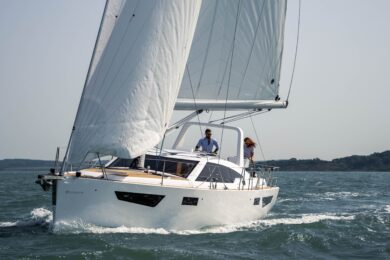
Hanse 495 • The future is here in the new German-built Hanse 495—more space, greater comfort, better sailing qualities and a truly modern look.
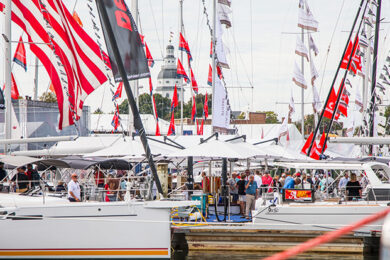
Hanse Yachts of Germany has been exporting their modern cruisers to North America for nearly a decade. We have reviewed several of the models in the pages of BWS and have discovered that the designs tend to stir definite responses from sailors. When you climb aboard a new Hanse at a boat show and mingle with showgoers—often couples who are seeing the boats for the first time—you get a lot of spontaneous reactions.
Some couples take one look and say, Nope, not traditional enough for us, while others stop in their tracks and utter Wow, this is the future.
Both are right. The newest designs from Hanse are not at all traditional; instead, they reflect the future with as much pizzazz as boats from any builder in the world. The hulls have plumb bows and sawn-off sterns that contain huge fold-down swim platforms. Under the water, the keels are often racy T-bulbs and the rudders deep, high aspect shapes you would expect on a grand prix racer. The tall rigs have large, full-battened mainsails, while the working headsails are small and self-tacking. The cockpits are huge, have twin wheels and are equipped with big drop-leaf tables. And often the sterns are wide open to the sea.
The Hanse 495 is not your granddad’s cruising boat by any stretch. The new boat, like its sisters in the Hanse fleet, is an eye-catching statement of modernist form following modernist function.
SEA TRIALS
It was a flat, calm morning off Manchester, MA when I met up with Bump Wilcox, the local Hanse dealer, to take the 495 for a test sail. An old Yankee, Bump assured me the fog would soon lift and a sea breeze would build. And so it did. By noon, we could see the harbor entrance and the surface of the water had a few ripples. We fired up the engine, dropped the mooring lines, switched on the bow thruster and pivoted the big sloop in its own length so we could motor down the narrow channel toward the sea.
As we cleared the harbor buoy and started to hoist the big mainsail, the ripples on the water were turning into waves and the sea breeze began to gain enthusiasm. The main has a double purchase, so the halyard is incredibly long, but it is a snap to raise the big, heavy sail. We got it up and drawing and soon had the small 100 percent jib rolled out and trimmed.
The North Shore is iron bound with rocky isles and reefs and coastal cliffs, so we had to pick our way seaward carefully as we tacked into the still building breeze. The 495, trimmed for close-hauled sailing, tacked effortlessly and accelerated quickly after each tack, all without any sheet trimming. We were sailing at 42 degrees true and making 8.5 knots in 15 knots of true breeze, and she felt well settled, had no weather helm and the decks were mostly dry.
Within an hour, the sea breeze was now a proper wind of more than 25 knots, so we decided to spare the new boat and headed off onto a power reach for a mile or so, then jibed around and ran for home. On the reach, with the wind just aft of the beam, the 495 had no trouble sailing at 10 knots and hit 12 a couple of times in the puffs. And off the wind on a broad reach, she was able to sail at 9 and 10 without trouble.
The one hitch with self-tacking headsails lies in the position of the sheet cars on deck; the tack trims well inboard on both sides, so when you are reaching, the head of the sail tends to twist off and lose power. The result is that you have to sail at about 160 degrees from the true wind and jibe your way toward your destination. For those who want to sail effectively downwind, you need to rig a lazy sheet to the jib that can be trimmed properly or you need to fly a reacher or code zero on a free flying roller forward.
We made it back in one piece and had a truly exhilarating sail. The Hanse 495 is a remarkably capable design that is easy to handle, has a pleasant motion in square chop and offers a fine turn of speed.
LIFE ABOARD
The Hanse 495’s interior layouts make optimum use of the huge amount of volume the designers have allocated in the hull. The topsides are quite high, so the underside of the decks inside the boat are not an impediment to lockers and sight lines. The hull carries its volume quite far forward and aft, so there is plenty of room for large cabin and storage spaces. And the hull has enough rocker under the water to make room below the floorboards for wine lockers and other storage areas.
The boat Bump and I sailed had the standard layout, with a large double berth in the owner’s cabin forward and two large quarter cabins aft under the cockpit. The forward head arrangement puts the toilet and sink in a closet to port and the shower in its own closet to starboard, so both spaces can be used at the same time. Aft, there is a single head and shower that serves both aft cabins and that will be a good wet locker for foul weather gear when underway on a foul day.
The saloon and the fit and finish of the cabinetry are what give the interior its wow factor. The galley lies along the port side of the saloon and is equipped with, naturally, a roomy wine cooler, a two-drawer fridge-freezer, a dishwasher, a three-burner stove and oven, a microwave oven, and two large stainless steel sinks. The granite-colored Corian counters add an elegant touch.
The dinette to starboard is U-shaped and huge. Eight adults will fit around the table, so you can entertain handsomely. The bench amidships doubles as a wet bar and storage area for wine and bar supplies. The table has drink holders built into it that will keep cups and glasses in place while underway.
The chart table on the starboard side is small for laying out large ChartKits, but well suited to the size of a laptop computer and smaller charts. Above it, a removable panel for electronics will be home to the chartplotter, radios, AIS and other navigation instruments.
Headroom throughout the boat is exceptional. The interior is full of light that flows through the large rectangular windows in the hull and the big windows that wrap around the cabin top. Plus, two large opening hatches overhead provide light and ventilation.
The boat we sailed had a light beech wood interior that was warm and attractive. The cabin soles were a very light-colored maple, which added to the interior’s brightness and gave the boat a completely nontraditional ambience. The blue faux leather upholstery in the dinette was handsome and set off the woods nicely.
For a family of four or a couple cruising with friends, the interior works very well. And, the saloon is large enough for about 20 of your friends to gather for sundowners. Add the huge cockpit into the mix and you could entertain 30, which is about as nontraditional a concept as you can get in an oceangoing cruising boat.
Hanse pioneered the “have it your way” process of personalizing your own boat through their online “configurator.” Similar in concept to the way you can customize a new BMW, the website allows you to choose your own layout, keel configuration, rig size, hull colors, interior finishes and much more. Once you have your boat just the way you want it, the website passes the information on to the nearest dealer, who will then call you for a more in-depth discussion. Very smooth.
If you are looking for a cruising boat that will take you boldly into the future as well as safely and comfortably to sea, the purposeful and handsome new Hanse 495 is well suited for the job.
Hanse 495
LOA 50’6”
LOD 48’9”
LWL 44’5”
Beam 15’7”
Draft 7’8”
Draft (shoal) 6’6”
Displacement 30,900 lbs.
Ballast 8,830 lbs.
Sail area 1,390 sq. ft.
Mast height 72’6”
Engine 72 hp. Diesel
Fuel 75 gals.
Water 165 gals.
DesignersJudel/Vrolijk
Moody DS 45 Magic • The Bill Dixon-designed pilothouse cruiser combines elegant indoor-outdoor living with fine sailing and cruising capabilities.
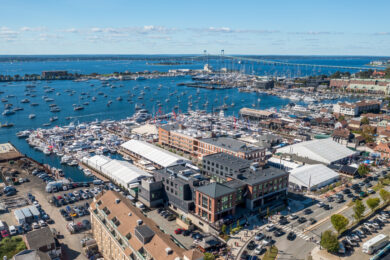
We sailed the Moody DS 45 in Newport, RI on one of those clear, warm fall days that make me realize how lucky I am to go sailing as part of my job. I was out with my old friend Alan Baines, who is the dealer for Moody in the Northeast and an accomplished sailor in his own right.
The Moody was lying to a mooring off the Jamestown Boat Yard, so we hitched a ride from a boatyard hand—the launch service had ended for the season—and climbed aboard just as the breeze began to build. There was still a little warmth in the sunlight, and across Narragansett Bay several classic 12 meters under charter were tacking easily seaward. Continue Reading…..
Hylas Yachts makes a luxurious world cruiser for a couple or family • The Hylas 54 proved to be one of the most successful 50-foot plus cruising boats ever built and continues to set a standard for a couple’s ultimate cruising boat. Yet, the design is now a decade old, and both design and styling trends have evolved among forward-looking builders around the world.
So when Dick and Kyle Jachney, owners of Hylas Yachts, decided to add a new boat to their line in the mid-50-foot range, they had the interesting challenge of taking what was best in the 54 and melding it with the latest thinking in cruising boat design and construction. The result is the new Hylas 56, which bears a strong family resemblance to the 54 but is also a confident step forward.
I got to sail the new 56 last fall after the Annapolis sailboat show. The weather had turned decidedly fall-like, with an easterly wind blowing sheets of rain descending on the Chesapeake Bay. It was a good big boat day when we could really see how the new boat sails and handles the square waves that were building.
As we motored out Back Creek, we put the 56 through its paces in forward, reverse and turning. The boat is driven by a 150 hp Yanmar diesel, which is a good size for a hull that displaces 50,200 pounds. Going from a dead stop to full speed took just under a minute, and the boat stopped when thrown into reverse in under three boat lengths. With the large rudder mounted on a half skeg, the boat circled on itself in about a boat length and half. All of this indicated that the 56 is handy under power, and—with the bow thruster engaged—simple to moor and unmoor, even in the gusty breeze we had that day.
Out in the bay we rolled out about two-thirds of the mainsail and set the roller furling staysail instead of the genoa. This reduced sail plan was perfect for the wind conditions, and the 56 was quickly close-reaching at 8.5 knots. As we trimmed and brought her close to the wind, the angle of the waves sent lots of spray onto the foredeck, but we did not get wet in the cockpit behind the dodger, and deck wash drained quickly aft. She settled down at about 48 degrees true off the wind and maintained 8 knots while heeling at about 15 degrees. Sighting aft, we appeared to be making very little leeway despite the waves and the strong breeze. And, the ride was remarkably stable and comfortable.
By the time we had thrown the 56 through a series of tacks, we were out in the middle of the bay and had a good angle for reaching back toward Back Creek. We rolled up the staysail and rolled out the genoa; with the added horsepower and the broad reach sailing angle, we started to fly. The speedo jumped to 10 knots, and occasionally we’d see 11 in the stronger puffs. The helm felt positive but light and the boat tracked well even though we had square waves rolling under the broad transom.
Off Back Creek, we rolled up the genoa and then turned into the wind to roll up the mainsail. With electric winches and furling systems, handling the big sails in the strong breeze was no problem at all. The 56 proved to be a very able boat under sail and power. She is stable, solid and inspires confidence while still turning out good speeds at all angles of sail. The design has a limit of positive stability of 125 degrees. For passagemaking, the new design will provide fast and comfortable passages anywhere in the world and will look after you when it gets bouncy out there.
DETAILS, DETAILS
The Jachneys have been building cruising boats for a long time, listening to their customers every step of the way. It is interesting to note that they seem to have tapped into the young CEO market of sailors who are looking for a luxury cruising boat with offshore capabilities at a competitive price. These guys do their homework, and when they compare a Hylas 56 to other boats in that size range, they have a hard time beating the combination of traditional styling, solid construction, seakeeping qualities and value.
Value is an interesting word that can connote low price or a lot for the money. In the case of the Hylas family of boats, which are built in Taiwan, the value lies in getting a lot for what you pay. And you will find it in the 56’s details.
The Frers-designed hulls are engineered for strength and durability instead of lightness. They are laminated of hand-laid glass fiber with alternating layers of Twaron, a carbon aramid fiber, in vinylester resin. The gel coat is an isophthalic resin for ultimate blister resistance. Below the water, two barrier coats of epoxy resin are applied as insurance against blisters.
The hull has two watertight bulkheads. The aft bulkhead seals off the rudderpost, so even with the rudder and post missing, the boat will still float. Forward, a collision bulkhead ensures that even a direct hit on a submerged container won’t violate the main hull.
Instead of using a balanced spade rudder, all of the Hylases designed by Frers have skegs that are integral with the hull laminate. This prevents flotsam damage underway and prevents rudder damage during a grounding. If you are venturing far afield, this extra level of rudder strength and protection is a real boon. The lead keel is a modified cruising fin with a small bulb that helps lower the center of gravity. For those who can’t work with the standard seven feet, four inches of draft, a keel-centerboard that draws only six feet, four inches with the board up has been designed.
The rig has been set up for long haul sailing with a minimum number of crew. Both the mainsail and the genoa have primary and backup halyards. Instead of using the single lowers made popular by masts with aft swept spreads, the 56 has fore and aft lowers that add extra support to the middle of the mast—particularly important when battling headwinds under a reefed main and staysail. The mast has discontinuous Hasselfors standing rigging with mechanical Sta-Lok end fittings, thus ruling out the dangers of going to sea with a cracked swage fitting.
The anchor locker is divided for two complete anchor rodes and there are two permanent anchor rollers at the stem head. The 56 is meant to be cruised far from the marina, so it needs to be securely and easily anchored by a couple.
A lot of thought has gone into the 56’s basic engineering and systems. The 150 hp Yanmar diesel is fitted with an easily used manual crankcase oil pump, so changing the engine oil every 100 hours is not a chore. That means you will actually do it, adding thousands of hours of life to your engine. Plus, the fuel system has two Racor filters that can be linked together or set up so one bypasses the other during maintenance. Finally, the engine compartment is fitted with a complete set of sensors and alarms, so any malfunction will be made known almost instantly.
You can tell a displacement cruising boat by its tanks. Not going anywhere? Small tanks. Exploring the world? Big tanks. The 56 has tanks for 280 gallons of fuel and 275 gallons of water—enough for four people, who conserve fresh water, for a month. And, it will power at low revs at about 6 knots for close to 1,000 miles.
One final detail: The 56 comes standard with four AGM 8Ds, which provide 840 amp hours of house battery storage and separate starting and bow thruster batteries. Such an ample reserve will mean you can run all of your systems with confidence.
LIVING ABOARD
The 56 was conceived as a passagemaking cruising boat for a family of adventurers. The saloon is open with ample headroom and will easily accommodate a party of 12 for cocktails and a family of eight for dinner at the dinette to port. The settee to starboard is a great place to lounge and will make a good sea berth.
The galley has been placed in the long passageway from the saloon to the master stateroom aft. The stove, fridges and several storage cupboards are mounted below the counter outboard, while the sinks are mounted above the engine compartment on the centerline, where they will drain on both tacks.
The master suite aft has a raised centerline double berth that will be easy to make up and comfortable to climb in and out of from both sides. There is ample storage space and hanging lockers for a couple living aboard in a variety of climes, and with opening ports on both sides and a large hatch overhead, ventilation will be great in the tropics. The master head is huge, with lots of lockers and a true separate shower stall.
Forward of the saloon, there is a snug upper and lower cabin to port that will work well for crew or children. Across from it lies the forward head, which also has a separate shower stall. The large guest cabin forward is virtually a second master cabin since it has a double centerline berth, a large hanging locker, and plenty of drawer and cabinet space.
One of the design touches we like aboard the 56 is the command center just aft and down a step from the dinette to port in the saloon. Here, you have a wraparound desk or chart table where you can install a full computer, run your laptops, operate the SSB, talk on the Iridium and navigate with your side-by-side multifunction displays. Or, if you are not headed to sea, you can run your company virtually from this executive suite of a nav station.
The new 56, like the recent Hylas models, is fitted out with teak panels, solid wood doors, teak or bamboo floors, and off-white overhead panels. The large wraparound windows in the saloon provide plenty of light without too much heat.
Furniture is built with traditional care. You will find louvered doors, solid door panels, fitted solid wood corner posts, and nicely handcrafted laminate pieces in the heads. Underfoot, you can have a traditional teak and holly sole or opt for more modern-looking bamboo floor panels. It is worth noting that all floor pieces have positive latches, so they won’t move or get loose when things get bumpy at sea.
A thoroughly warm and inviting interior is much prized by families living aboard for any length of time. The cabins offer great private spaces, while the saloon and large center cockpit provide plenty of room for socializing.
The new Hylas 56 is a lovely evolution from the 54. And, like the earlier design, this 56-footer has the legs to take you anywhere you might want to sail.
Hylas 56 specs
LOA 56’4”
LWL 50’5”
Beam 15’10”
Draft (deep) 7’4”
Draft (shoal keel/cb) 6’4”/10’
Displacement 50,200 lbs.
Ballast 20,200 lbs.
Sail Area 1821 sq. ft.
Water 275 gals.
Fuel 280 gals.
Mast height 73’0”
Hylas Yachts
Marblehead, MA
800-875-5114
www.hylasyachtsusa.com
Island Packet 360 • This new mid-size bluewater cruiser will make a fine and sensible couple’s cruising boat
The Island Packet 360 debuted at last fall’s Annapolis sailboat show and caused a nice stir among the boatbuilder’s many fans. The new boat shows some definite evolutionary traits while maintaining the qualities that make Island Packets so admired in the cruising fleet.
The 360 is built using the same hull as the popular Estero, which was launched a few years ago. The hull has a slightly more plumb bow than the current fleet of Island Packets and stirs memories of the great early boats that made Island Packet famous. The boat’s bowsprit is a bit longer than we see in the larger boats, which spreads out the sailing rig, provides a good anchoring platform and gives the 360 a decidedly classic and salty look.
Under the water, the 360’s hull has the same Full Foil Keel, shallow draft and attached rudder that you see on her sister ships. The hull design offers a sea kindly motion, a high degree of stability, some positive lift when sailing to windward and, of course, the minimum draft that allows you to really gunkhole close to the coastline. For those who are sailing far afield, this hull shape will take a grounding better than a fin keel design, will better protect the rudder and propeller, and will allow you to dry out or careen the boat for quick repairs or refreshing the antifouling paint.
The 360 has a fairly tall cutter rig with the staysail flying on the patented Hoyt Jib Boom. With roller furling on all three sails and a self-tacking staysail, the 360 is an automated cruising boat. And because the sails are all fairly small, even the lightest and smallest crewmember can trim, reef and furl them.
The 360 sports an all-new interior that combines the warmth of traditional varnished teak joinery with the brightness of light-colored laminates and countertops. The boat offers two large, private double cabins and has a large head forward with a separate shower stall. The galley is huge and has twin refrigerators (either of which can be used as a freezer), a propane stove and oven, a microwave, and plenty of storage above and below the counters.
The L-shaped settee to port has a table that folds down from the main bulkhead, and across from the dinette are two swiveling easy chairs. There are storage lockers behind the settee and the chairs, and a small table fits neatly between the chairs for drinks or playing cards. The chart table folds up from the galley cabinet, where the navigator can use it while sitting in the aft easy chair.
The interior is spacious and homey, with plenty of natural light and ventilation. For a couple who likes to cruise with another couple or their children, the 360 offers a lot of accommodations in a manageable and affordable package.
After the Annapolis show, we had the chance to sail the boat before it was delivered to the nearby dealership at Gratitude Yacht Sales. The morning breeze was light and the Chesapeake Bay was lovely in the early autumn warmth. Off the Naval Academy we rolled out the mainsail and then the genoa and the 360 responded nicely. At 19,300 pounds, she is no lightweight, but even so the ample sail area easily turned the light breeze into 5 knots of boat speed. She seemed to almost be making her own wind.
We tacked up the Severn River next to the Academy where the breeze was building. The 360 tacked easily through 90 degrees and maintained her way while making very little leeway.
At the fixed bridge across the river, we bore off onto a broad reach and rolled out the staysail to give us maximum sail area. The 360 responded well and soon the bow wave was hissing nicely along the hull and the wake stretching away smoothly. This is the kind of pleasant sailing that we would have been happy with all day.
But we didn’t have all day, so after a few jibes downwind, we rolled up the sails and headed back into Annapolis under power. The 360 motors efficiently and is easy to steer and maneuver. We brought her in alongside a dock in town without any fuss and then backed and turned her within a boat length.
The new Island Packet 360 does a lot of things well. She is a capable ocean sailing boat with excellent accommodation for living aboard. She is built to the highest standards and carries ABYC and CE offshore ratings. If you are looking for a handy, mid-size blue water boat that is also a lot of fun to sail, the new 360 should definitely be on your list. Take her sailing and you won’t look back.

Island Packet Yachts
1979 Wild Acres Rd.
Largo, FL
33771
727-535-6431
www.ipy.com
Island Packet 360
LOA 36’5”
LWL 31’6”
Beam 12’4”
Draft 4’0”
Mast height 54’0”
Water 110 gals.
Fuel 55 gals.
Displ. 19,300 lbs.
Sail area 831 sq. ft.
Engine 40-hp.
![]()
NEWS AND NOTES

BLUE WATER SAILING MEDIA

![]()
BLUE WATER SAILING, CRUISING COMPASS & MULTIHULLS QUARTERLY
Welcome to Blue Water Sailing!
Blue Water Sailing is now in its 15th year of publication and reaches readers across North America and in 66 countries. The magazine was founded by circumnavigators George and Rosa Day, who spent five years sailing and cruising their Mason 43 ketch around the world. Blue Water Sailing was designed to offer great sailing stories and real-world solutions for offshore sailors who need to fit out their cruising boats to meet the rigors of the ocean. In every issue, you will find authoritative articles written by known experts covering everything from sail related gear to the navigator’s table to the art of cruising.
And, every week, we publish the e-newsletter Cruising Compass, which is your weekly fix of cruising news, technical advice, sailing resources and fun events. BWS’s sister publication, MQ, has launched a blog for multihull enthusiasts to talk about everything from the America’s Cup, wing masts and asymmetrical daggerboards to the best gear for cruising. Plus, check out our newest venture, NE Mountain Sports, which offers destination features, snow reports, trail conditions and travel planning for active Northeasterners who love to ski, snowboard, bike, climb, hike, kayak and camp.
Fair winds,
George & Rosa Day